
Previous Works
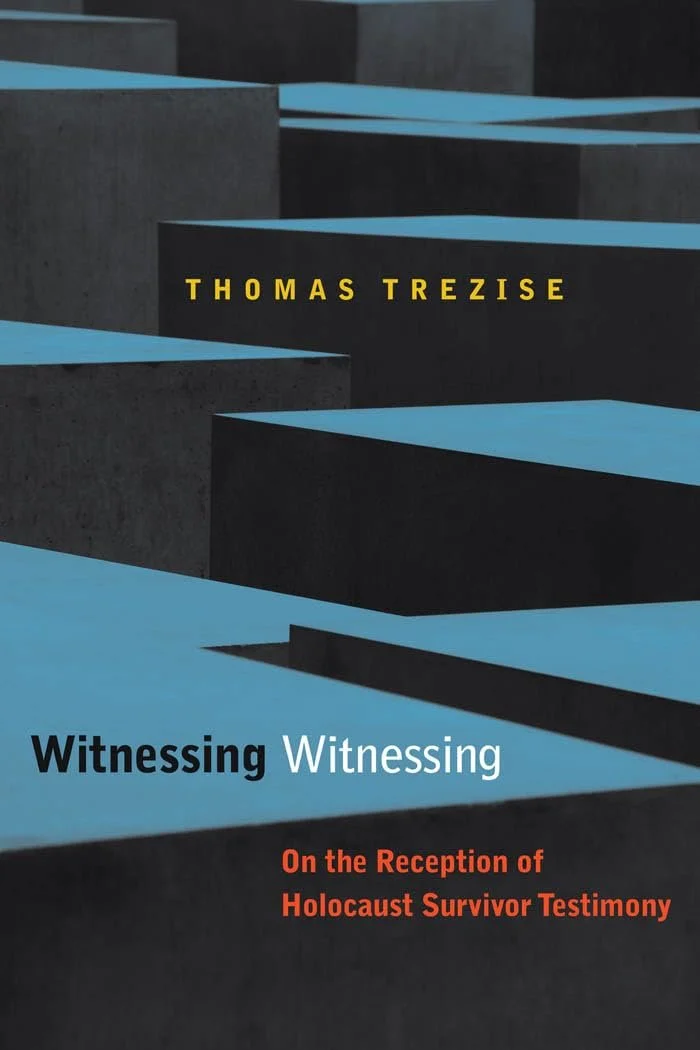
Witnessing Witnessing:
On the Reception of Holocaust Survivor Testimony
Witnessing Witnessing focuses critical attention on those who receive the testimony of Holocaust survivors. Questioning the notion that traumatic experience is intrinsically unspeakable and that the Holocaust lies in a quasi-sacred realm beyond history, the book asks whether much current theory does not have the effect of silencing the voices of real historical victims. It challenges widely accepted theoretical views about the representation of trauma in general and the Holocaust in particular, and seeks to make survivors’ voices heard. It also clarifies the problems that anyone receiving testimony may encounter, emphasizing how listening to survivors depends on listening to ourselves and to one another.
“Combining admirable lucidity in examining complex problems, a non-aggressive but effective mode of critique, and an impressive knowledge of the literature pertinent to the topics he treats, Trezise investigates an influential array of critical theorists and/or survivors, including Dori Laub, Cathy Caruth, Berel Lang, Theodor W. Adorno, Charlotte Delbo, Giorgio Agamben, Primo Levi, Emmanuel Levinas, and Jorge Semprun.”—Dominick LaCapra, Cornell University
“In Witnessing Witnessing, Thomas Trezise makes an eloquent plea for respecting the specificity of survivor testimonies against the theoretical tendency to generalize or universalize. With fine-grained interpretations of both classic testimonies and some of the most influential theories they have inspired, this book is not only a valuable intervention in the ongoing debates about representations of the Holocaust and other historical traumas, it is also a lesson in the art of careful reading.”—Susan Suleiman, Harvard University
“In a series of illuminating reinterpretations and trenchant critiques of classic texts, Witnessing Witnessing challenges fundamental assumptions about Holocaust testimony.This book will surely provoke debate and disagreement, but its profound commitment to ethical listening is inspiring.”—Marianne Hirsch, author of The Generation of Postmemory: Writing and Visual Culure after the Holocaust
________________________
Into the Breach
Samuel Beckett and the Ends of Literature
Arguing that Samuel Beckett’s understanding of subjectivity exceeds the framework of phenomenology or existential humanism, Thomas Trezise offers a major reinterpretation of Beckett’s work in light of Freud and such later theorists as Georges Bataille, Maurice Blanchot, and Jacques Derrida. Through extended comparisons of Beckett’s trilogy of novels with the writings of these thinkers, he emphasizes a “general economy” of signification that both produces and dispossesses the phenomenological self. The undoing of historical time in an abyssal repetition, the involvement of the subject with an impersonal alterity, the priority of error, the notion of art as an inspired failure—at once an impossibility and an imperative rather than an act of freedom and power—all suggest that Beckett’s literary corpus be considered an exploration of the breach that this artistic failure opens in traditional philosophical approaches to the human subject.
“Somehow we have felt that Samuel Beckett expresses our age, but we have not been able to explain why with very much precision. By employing the concepts and vocabulary of postmodernist philosophy, Trezise unlocks the mysteries of Beckett’s trilogy, the most brilliantly sustained expression in literature of postmodernist insights.”—Peter Bien, Dartmouth College
“Trezise’s book is extremely important as a contribution to Beckett studies, which it should significantly deflect. It is also a significant intervention in the theoretical field broadly associated with ‘deconstruction.’”—Ross Chambers, University of Michigan